The Aztec empire fell in 1521, yet its imagery has outlived five centuries of colonization, academic reinterpretation, and pop culture recycling to end up on the reels of a modern slot machine. That staying power is not an accident. Sun disks, jade masks, obsidian blades, and feathered serpents carry a visual density that translates well to reel symbols, and game designers have known this for years. The Aztec priestess slot is one of the more recent entries in this long tradition, and it distinguishes itself by leaning into ritual accuracy rather than generic "ancient temple" tropes.
What makes this particular title worth examining is the layering of two separate systems: a mythological framework borrowed from Mesoamerican cosmology, and a mechanical framework built around volatility, paylines, and return-to-player math. Readers who want the mechanical side up front can check the aztec priestess rtp before going further, since payout percentage often dictates whether a themed slot is worth extended play regardless of how compelling its artwork is. The rest of this piece, however, focuses on the substance behind the symbols - where they come from, what they meant to the people who created them, and how that meaning gets repackaged for a casino audience.
Understanding both halves matters. A player who recognizes Tlaloc's goggle-eyed mask or the significance of a jaguar warrior engages with the game differently than one who sees only decoration. This article breaks down the mythology, the ritual symbolism, the gods most commonly depicted, and the technical features that determine whether the game is generous or punishing over the long run.
What Is the Aztec Priestess Slot?
Core Concept and Visual Identity
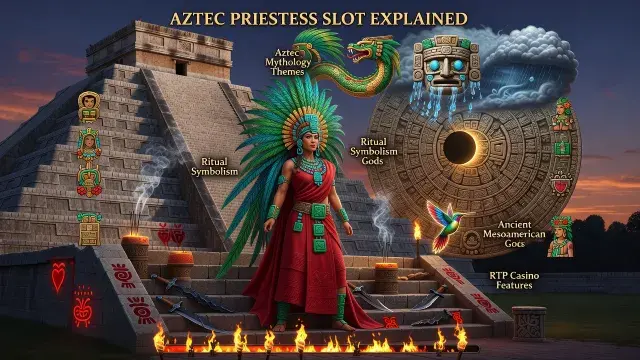
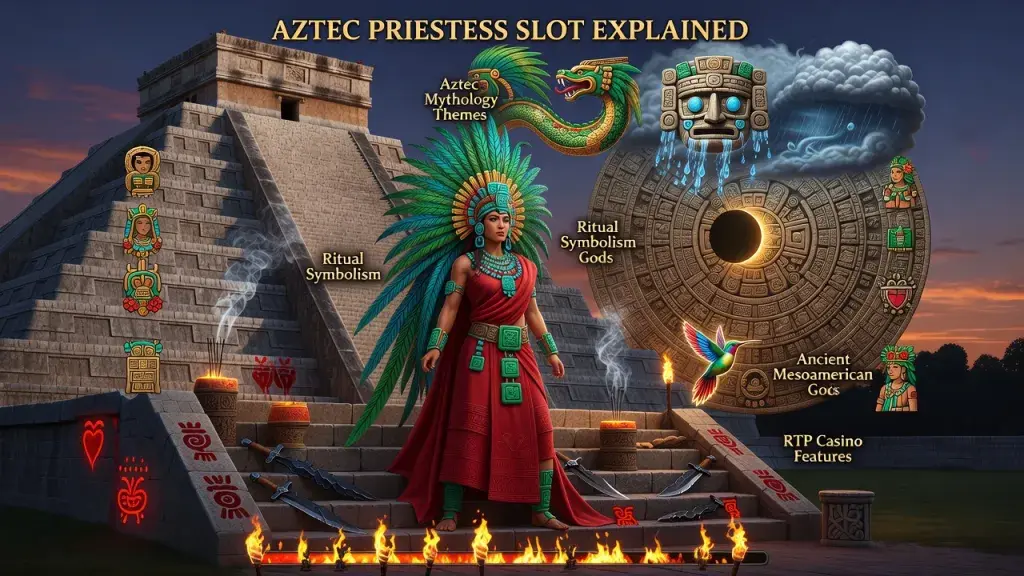
The Aztec priestess slot centers on a female religious figure - a composite invention rather than a documented historical person - who serves as the game's wild symbol or bonus trigger. Her costume design typically draws on quetzal feathers, turquoise jewelry, and cotton garments dyed with cochineal red, all materials that carried status in actual Aztec society. Developers use her as a narrative anchor: she is the one who "invites" the player into the temple setting, and her appearance on the reels usually signals an upgrade in the reward structure.
How It Fits Within the Broader Slot Genre
Ancient civilization themes are a saturated category in online gambling. Egyptian pyramids and Greek pantheons dominate the space numerically, which makes Mesoamerican-themed titles a smaller but distinct niche. The Aztec priestess slot competes in this niche by offering aesthetic novelty - step pyramids instead of triangular ones, calendar stones instead of ankh symbols - while keeping the underlying mechanical formula familiar to anyone who has played a five-reel video slot before.
Target Audience and Player Expectations
Players drawn to this category tend to fall into two overlapping groups: those interested in history-flavored entertainment and those simply hunting for a well-paying game with an attractive skin. Designers who understand this split usually try to satisfy both by pairing accurate visual research with competitive volatility settings, an approach that becomes clearer once the RTP mechanics are examined later in this piece.
Aztec Mythology Themes in the Game
Creation Myths and the Five Suns
Aztec cosmology holds that the world had already been destroyed and recreated four times before the current age, known as the Fifth Sun. Each previous era ended in catastrophe - flood, jaguar attack, wind, fire - and the gods sacrificed themselves to set the fifth world in motion. Slot designers reference this cycle through symbols like the sun stone or eclipse imagery, often tied to the game's highest-value scatter or bonus round, since the "end of an age" narrative maps neatly onto a jackpot or free-spins trigger.
The Role of Sacrifice and Renewal
Sacrifice in Aztec belief was not gratuitous violence; it was an act of reciprocity, a debt paid to gods who had already sacrificed themselves for humanity's benefit. This theme shows up in the Aztec priestess slot through symbols depicting offerings - bowls of maize, blood glyphs rendered abstractly, or a knife resting beside a heart motif. These are stylized rather than graphic, since commercial gaming platforms avoid explicit violence, but the underlying concept of exchange still drives the bonus logic: give up a spin, receive a multiplier.
Calendar Systems and Time Symbolism
The Aztecs operated two interlocking calendars - the 260-day tonalpohualli and the 365-day xiuhpohualli - which aligned only once every 52 years, an event marked by elaborate New Fire ceremonies. Slot games frequently borrow the circular calendar stone as a visual motif for progress bars or spin counters, since its segmented design already resembles a game meter. This is one of the clearer examples of Aztec mythology themes being repurposed for functional game design rather than pure decoration.
Ritual Symbolism and Ceremonial Imagery
Common Ritual Ceremony Symbols on the Reels
Certain visual elements recur across nearly every Aztec-themed slot because they are instantly recognizable even to players with no background in Mesoamerican history. These ritual ceremony symbols function as both storytelling devices and payout triggers:
- Obsidian blades, referencing tools used in bloodletting rites and temple offerings
- Copal incense burners, tied to purification rituals performed before major ceremonies
- Feathered serpent motifs, representing Quetzalcoatl and often used as wild symbols
- Stone temple steps, evoking the pyramid structures where public rituals took place
- Jade masks, historically reserved for elite priests and nobility, usually mapped to high-value symbols
The Priestess as Ritual Officiant
Women held documented religious roles in Aztec society, including positions tied to specific temple cults, though the elaborate solo "priestess" figure common in slot branding is a dramatized composite rather than a strict historical portrait. Her presence on the reels typically triggers a ceremonial animation - incense smoke, chanting glyphs, a burst of feathers - that reinforces the ritual atmosphere without requiring the player to understand the underlying history.
Color and Material Symbolism
Turquoise signified water and rulership; red, drawn from cochineal insects, symbolized blood and life force; jade represented preciousness beyond gold, since gold was comparatively common in the region. Slot artists apply this palette deliberately. A game that gets the color coding wrong - using purple for royalty instead of turquoise, for instance - signals a lack of research to players who know the source material, which is part of why accuracy matters even in a purely commercial product.
Ancient Mesoamerican Gods Featured in the Slot
Quetzalcoatl and the Feathered Serpent
Quetzalcoatl, associated with wind, learning, and the morning star, is arguably the most internationally recognized deity from the Aztec pantheon, largely because his iconography - a serpent covered in quetzal feathers - is visually striking and easy to stylize. In most Aztec-themed slots, he appears as a top-tier symbol or the game's wild card, since his mythological association with rebirth pairs naturally with respin or multiplier mechanics.
Tlaloc, Huitzilopochtli, and Other Key Deities
Tlaloc, the rain god associated with both fertility and destructive storms, often appears through goggle-eyed mask imagery and is linked to bonus rounds involving water or flood animations. Huitzilopochtli, the patron deity of the Aztec capital Tenochtitlan and a war deity tied to the sun's daily battle against darkness, frequently anchors the game's scatter symbol given his central role in state religion. Other deities like Xochiquetzal, associated with beauty and craftsmanship, sometimes appear in a supporting role, reinforcing the priestess character's aesthetic rather than her narrative function.
How These Gods Are Adapted for Slot Symbolism
Game artists compress complex theological roles into single, legible icons: a serpent for Quetzalcoatl, a mask for Tlaloc, a hummingbird motif for Huitzilopochtli, whose name translates roughly to "hummingbird of the south." This compression sacrifices nuance for clarity, which is a necessary trade-off in a format where players glance at symbols for a fraction of a second per spin. It does mean, though, that anyone wanting a fuller picture of ancient Mesoamerican gods should treat the slot as an entry point rather than a complete education.
RTP and Casino Slot Features
Understanding Return to Player in This Context
Return to player, expressed as a percentage, indicates the theoretical proportion of wagered money a slot returns to players over a large number of spins. A title advertising a 96% RTP is expected to pay back 96 cents of every dollar wagered across millions of spins, with the remaining margin retained by the operator. This figure is a long-run statistical average, not a guarantee for any individual session, and it should be checked directly on the operator's game information page since exact figures vary by platform and jurisdiction.
Volatility, Paylines, and Bonus Mechanics
RTP casino slot features extend beyond the headline percentage. Volatility determines how payouts are distributed - a high-volatility Aztec priestess slot will pay rarely but generously, often through free-spin rounds triggered by the priestess or a temple scatter symbol, while a low-volatility version pays more frequently in smaller amounts. Paylines, wild multipliers, and cascading reel mechanics all interact with the base RTP to shape the actual player experience, which is why two games with identical RTP figures can feel completely different to play.
Free Spins, Multipliers, and Bonus Rounds
Bonus structures in this genre commonly tie back to the mythological framework already discussed. A "New Fire" free-spins round, referencing the 52-year Aztec ceremony, might award escalating multipliers with each successive spin. A sacrifice-themed bonus might ask the player to select symbols representing offerings, each concealing a different multiplier value. These mechanics are not arbitrary additions - they are the mythology restructured into a probability engine, which is the fundamental design principle behind nearly every culturally themed slot on the market.
Frequently Asked Questions
Is the Aztec priestess character based on a real historical figure?
No single documented individual matches the character exactly. She is a composite drawing on real evidence of female religious roles in Aztec society, combined with artistic license to create a marketable protagonist for the game.
Do higher RTP percentages guarantee better short-term results?
No. RTP is calculated over millions of spins and says nothing about what happens in a single session of fifty or a hundred spins. Volatility has a much larger effect on short-term outcomes than a one or two percentage point difference in RTP.
Why do so many slot games use Aztec and Mesoamerican imagery specifically?
The visual language of Aztec art - bold geometric patterns, vivid color contrasts, and symbol-dense iconography like calendar stones and feathered serpents - translates unusually well to the grid-based format of slot reels, giving designers a rich source of distinct, legible symbols.
Are the ritual ceremony symbols in the game historically accurate?
Many individual elements, such as obsidian blades, copal incense, and jade ornamentation, are grounded in documented Aztec practice. The way they are combined and animated for entertainment purposes, however, compresses and simplifies rituals that were far more complex and context-specific in reality.
Which Mesoamerican god appears most frequently across these types of slots?
Quetzalcoatl appears most consistently, largely because the feathered serpent design is visually distinctive and easy to render as a wild or scatter symbol, and because he is the deity most widely recognized outside specialist historical circles.
Should players research the mythology before playing, or is it optional?
It is entirely optional for gameplay purposes, since the mechanics function independently of historical knowledge. Players interested in getting more value from the theme, rather than just the payouts, will find that understanding the gods and rituals behind the symbols adds context that pure gameplay does not provide.