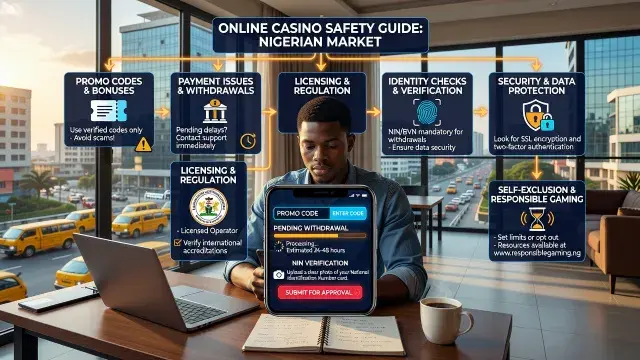
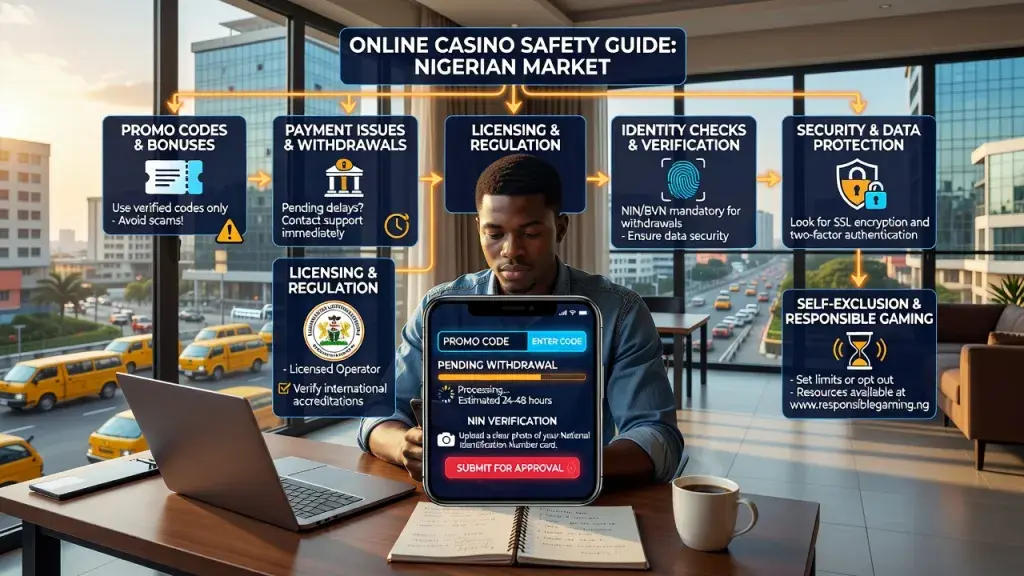
A withdrawal that sits in "pending" for four days is not automatically fraud, but it is a signal worth reading correctly. Most online gambling problems fall into predictable categories: a bonus that never converts to real money, a deposit that bounces without explanation, a license that sounds official but means nothing, or an account that keeps a player tethered long after they wanted to stop. None of these issues are random. Each has a mechanical cause, and once you understand the mechanics, the panic that usually accompanies them disappears.
This guide walks through the practical realities of playing at regulated and unregulated platforms alike, with a specific focus on the Nigerian market, where licensing rules, identity verification, and payment infrastructure differ sharply from what players in Europe or North America experience. If a withdrawal request has already stalled, contacting support directly often resolves the confusion faster than guessing - for licensed sports betting queries, the nbet customer care number is a reasonable first stop before assuming the worst. Along the way, we'll cover how bonus codes actually work, why banks reject certain transactions, what "offshore license" really means, and how to spot a copycat brand before it drains your account.
What Promo Codes Really Are and How They Work
The Mechanics Behind Bonus Codes
What are promo codes for online casinos? At the simplest level, they are alphanumeric strings tied to a specific promotional campaign in the operator's backend system. When entered during registration or deposit, the code flags the account for a defined reward - free spins, a deposit match, or a fixed bonus amount. The code itself carries no monetary value; it is a trigger that activates a pre-configured offer. Operators use codes to track which marketing channel brought in a player, which is why the same casino might issue different codes for a banner ad, an affiliate link, or a social media post.
Reading the Fine Print Before Claiming
The real cost of a promo code sits in the wagering requirement attached to it. A 100% match bonus with a 40x rollover means a player depositing 10,000 naira must wager 400,000 naira in qualifying bets before withdrawing any bonus-derived winnings. Game restrictions matter too - many bonuses exclude live dealer tables or cap the contribution of slots differently from table games. Skipping the terms page is the single most common reason players feel cheated by an offer that was, technically, exactly as advertised.
- Check the minimum deposit required to activate the code
- Confirm the wagering multiplier and which games count toward it
- Note the expiration window - many bonuses void after 7 to 30 days
- Verify maximum withdrawal caps tied to bonus winnings
Why Deposits and Withdrawals Go Wrong
Common Reasons Deposits Fail
Why do online casino deposits fail? The causes are usually mundane rather than sinister. Nigerian banks frequently flag gambling-related merchant codes and block the transaction automatically, especially with cards not pre-authorized for international or "high-risk" spending categories. Insufficient funds, expired card details, and daily transaction limits set by the issuing bank account for a large share of failures. Some banks specifically restrict transactions to platforms categorized under gambling merchant codes regardless of the operator's legitimacy, meaning even a fully licensed casino can trigger a decline that has nothing to do with the site itself.
Understanding Pending Withdrawal Status
Why is my casino withdrawal pending? Reputable operators impose a review window - often 24 to 72 hours - during which the payments team verifies the transaction against fraud checks, bonus wagering completion, and identity documents. This is standard, not suspicious, unless the pending status extends well beyond the operator's stated timeline. A withdrawal can also stall if the player used a different payment method for depositing than the one selected for withdrawal, since many platforms require funds to exit through the same channel they entered.
What to Do When a Transaction Stalls
Screenshot the transaction details immediately, note the timestamp, and check the operator's stated processing window before escalating. If the delay exceeds that window, contact support with the transaction ID rather than a general complaint - specificity moves tickets faster through queues.
Licensing: The Difference Between Legal and Legitimate-Looking
What an Offshore Casino License Actually Covers
What is an offshore casino license? It's a permit issued by a jurisdiction - Curacao, Malta, the Isle of Man, among others - that allows an operator to accept players internationally, often with lighter regulatory oversight than a domestic license would require. Curacao licenses, historically the cheapest and most common among small operators, have long been criticized for minimal enforcement and weak dispute resolution mechanisms. An offshore license is not inherently fraudulent, but it offers players far less recourse than a license issued by their own country's regulator.
Nigerian Licensing Requirements for Betting Operators
What licenses do legal betting operators need in Nigeria? Operators taking bets from Nigerian players are expected to hold authorization from the National Lottery Regulatory Commission for federal-level operations, alongside state-level licenses in jurisdictions like Lagos that maintain their own regulatory bodies. A genuinely licensed operator will display registration numbers and regulator names openly, not buried in a footer link that goes nowhere.
- National Lottery Regulatory Commission authorization for nationwide operation
- State gaming board licenses where applicable, such as Lagos State Lotteries Board
- Clear display of license numbers verifiable through the regulator's public registry
Identity Verification and Why It Protects You
NIN Verification Explained
What is NIN verification for online platforms in Nigeria? The National Identification Number system ties a unique 11-digit identifier to biometric and demographic data held by the National Identity Management Commission. Licensed betting and gaming platforms increasingly require NIN submission to confirm a player's age, identity, and residency before processing withdrawals. This isn't bureaucratic friction for its own sake - it's the mechanism that prevents underage gambling and blocks the use of stolen payment credentials.
Why KYC Delays Frustrate Players but Serve a Purpose
Know-your-customer checks feel invasive when you're waiting on a payout, but the alternative - no verification at all - is exactly what unregulated platforms rely on to avoid accountability. A platform asking for a government ID, proof of address, and NIN confirmation before a large withdrawal is doing its job, not stalling on purpose.
Account Security: Passwords Are Not Enough
Two-Factor Authentication at Online Casinos
Is two factor authentication available at online casinos? Most licensed operators now offer it, typically via SMS code or an authenticator app, though it's frequently opt-in rather than mandatory. Enabling it closes the most common attack vector - credential stuffing, where leaked passwords from unrelated breaches get tested against gambling accounts because password reuse is rampant. A platform that doesn't offer two-factor authentication at all, in an era where it's standard across banking apps, is worth treating with suspicion.
Spotting Copycat and Clone Casino Sites
How to identify copycat casino brands? Scammers frequently clone the visual identity of a licensed, trusted operator - same logo, near-identical domain name with a swapped letter or extra hyphen - to intercept deposits meant for the real site. Checking the domain character by character, verifying the license number against the regulator's official database, and confirming the site through the operator's official social media channels are the three checks that catch nearly every clone.
- Compare the domain letter-by-letter against the known official URL
- Cross-check the displayed license number on the regulator's public site
- Look for inconsistent branding, broken links, or unusually aggressive bonus claims
Self-Exclusion and Responsible Gambling Tools
How Self-Exclusion Periods Work
How long can you self exclude from a casino? Most licensed platforms offer tiered options - 24 hours, 7 days, a month, six months, or permanent closure - and reputable operators do not allow early reversal once a period is set, precisely because impulsive reversal defeats the purpose. Some jurisdictions also run centralized self-exclusion registries covering every licensed operator at once, rather than requiring separate requests site by site.
Using Blocking Apps as an External Safeguard
How do gambling blocking apps work? These applications operate at the device or network level, maintaining a continuously updated blocklist of gambling domains and payment gateways associated with betting sites, then intercepting attempts to access them. Unlike a casino's internal self-exclusion tool, a blocking app doesn't rely on the platform's cooperation - it works even against sites the user hasn't previously visited, which makes it a stronger safeguard for anyone rebuilding control after a lapse.
Combining Tools for Real Protection
Self-exclusion and blocking software work best together rather than as alternatives. A determined person can often find a new unlicensed site to sidestep one platform's exclusion, but a device-level block closes that loophole regardless of which brand shows up next.
Question?
Can I get my deposit back if a casino declines it after the money leaves my account?
If your bank shows the transaction as completed but the casino never credited it, the funds typically return automatically within a few business days as a reversal, since the payment never actually settled with the operator. If it doesn't reverse within a week, contact your bank directly with the transaction reference rather than waiting on the casino.
Question?
Does a Curacao license mean a casino is untrustworthy?
Not automatically. Many Curacao-licensed operators run clean, well-managed platforms, but the license itself provides weaker dispute resolution than a domestic regulator would, so players have less formal recourse if something goes wrong.
Question?
Why do some platforms ask for NIN even for small deposits?
Some operators verify identity upfront rather than waiting until withdrawal, which reduces fraud risk and speeds up the payout process later since the check is already complete.
Question?
Is it normal for a casino to reject my withdrawal method and ask me to use a different one?
Yes, this usually happens because the platform requires withdrawals to route through the same payment method used for the deposit, a standard anti-fraud measure rather than an attempt to delay payment.
Question?
Can I self-exclude from just one game type instead of the whole platform?
Most operators only offer full-account exclusion rather than partial restrictions on specific games, since granular self-exclusion is harder to enforce technically and easier to circumvent.
Question?
What should I do if I suspect I've been playing on a copycat site?
Stop all transactions immediately, contact your bank to flag potential fraud on the card used, and report the fake domain to the licensed operator whose brand was copied so they can pursue a takedown.