A single attack helicopter can destroy more armor in one sortie than an entire tank platoon fires in a day, yet it costs a fraction of what a fixed-wing strike aircraft demands to build and operate. That arithmetic has shaped ground combat since the 1970s and continues to define how modern militaries think about firepower, mobility, and survivability on contested terrain. Helicopters occupy a strange middle ground between infantry and airpower - fast enough to react within minutes, precise enough to hit a single vehicle, and vulnerable enough that entire doctrines exist purely to keep them alive.
Understanding helicopter warfare strategy means understanding this tension between reach and fragility. Rotary-wing aircraft trade the speed and payload of jets for the ability to hover, land in a clearing, and support troops directly on the ground where a fighter jet simply cannot linger. Those interested in how this dynamic plays out in simulated combat scenarios sometimes explore it through unconventional formats - even a themed wagering title built around helicopter x strategy borrows from the same principle of timing risk against reward, mirroring the split-second decisions pilots make under fire. The real-world version, though, carries consequences measured in lives and territory, not credits.
This piece breaks down how helicopters are deployed, why they became the tank's most feared adversary, what keeps them fueled and armed near the front line, and how air mobility doctrine ties all of it together into a coherent battlefield system.
Foundations of Helicopter Warfare Strategy
Helicopter warfare strategy did not emerge from a single doctrine document. It grew out of necessity - commanders needed a platform that could move troops over obstacles, strike targets too fast for artillery to reach, and evacuate wounded soldiers without waiting for roads to clear. That necessity produced three distinct but overlapping missions: transport, attack, and reconnaissance. Each mission shaped a different airframe, a different training pipeline, and a different set of risks.
Origins and Evolution from Korea to Modern Conflicts
Helicopters first proved their worth as medical evacuation platforms during the Korean War, pulling wounded soldiers from terrain that trucks could never cross. Vietnam expanded that role dramatically, introducing air assault as a standard infantry insertion method and revealing how vulnerable slow-moving rotary aircraft were to small-arms fire. By the Gulf War, attack helicopters had matured into precision anti-armor platforms, and subsequent conflicts in the Balkans, Afghanistan, and Ukraine have each stress-tested the doctrine further, particularly around survivability against modern air defense networks.
Core Principles: Speed, Surprise, and Vertical Envelopment
Vertical envelopment - inserting forces behind or beside an enemy position by air rather than by ground assault - remains the conceptual backbone of helicopter operations. Speed compresses the enemy's decision cycle, and surprise multiplies the effect of a numerically smaller force. These principles only work, however, if commanders accept the tradeoff: helicopters need suppressed air defenses and reasonably permissive skies to operate without catastrophic losses.
Roles Across Branches: Army, Marine, and Special Operations Use
Army aviation typically emphasizes deep-strike attack missions and air assault, Marine aviation ties rotary assets directly to amphibious landing sequences, and special operations units favor stripped-down, low-signature aircraft for infiltration and exfiltration under cover of darkness. Each branch adapts the same basic airframes to different tactical philosophies, which is why a single helicopter design can serve wildly different missions depending on who flies it.
Helicopter Deployment Tactics on the Modern Battlefield
Deployment tactics answer a practical question: how do you get a helicopter to the right place, at the right time, without losing it to enemy fire? The answer changes constantly as radar, missiles, and drones evolve, forcing pilots and planners to rethink formations and flight profiles almost every decade.
Low-Altitude Terrain Flying and Nap-of-the-Earth Tactics
Flying just above treetops and ridgelines - nap-of-the-earth flight - lets a helicopter use terrain masking to stay below radar coverage and out of missile lock-on range until the last possible moment. It demands intense pilot concentration and increases the risk of controlled flight into terrain, but it remains one of the few reliable ways to survive contested airspace without stealth technology.
Formation Flying and Coordinated Strike Packages
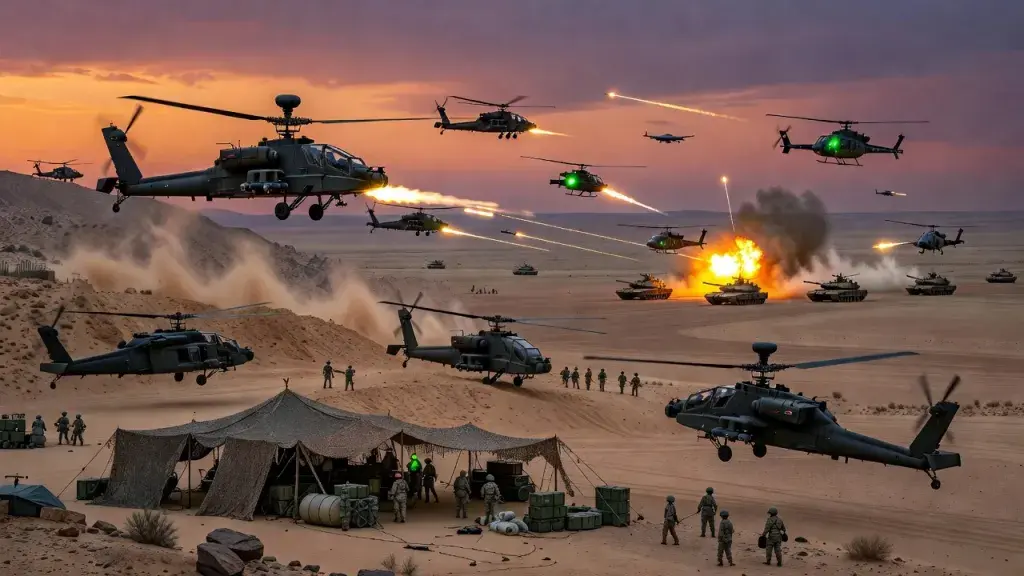
Attack helicopters rarely operate alone. A typical strike package pairs armed gunships with a scout aircraft that identifies targets and calls in engagements, while additional aircraft provide overwatch against ambush. This layered approach reduces the chance that a single air defense system can engage the whole formation simultaneously.
Night and All-Weather Operations
Night vision systems and forward-looking infrared sensors turned darkness into an advantage rather than a limitation, letting crews strike when enemy air defenses are least alert. All-weather capability, though, still lags behind fixed-wing aircraft - heavy fog, icing, and severe turbulence ground rotary operations far more often than they ground jets.
Landing Zone Selection and Extraction Planning
Choosing a landing zone involves balancing concealment, approach angles, and escape routes against the tactical need to land close to the objective. Extraction planning gets less attention publicly but matters just as much - a poorly chosen pickup point can turn a successful raid into a stranded unit under fire.
- Terrain masking to avoid radar detection
- Multi-aircraft strike packages with dedicated scout and overwatch roles
- Night vision and infrared targeting for low-light superiority
- Pre-planned primary and alternate landing zones
Anti-Tank Helicopter Strategy and Armor Suppression
No development reshaped ground combat doctrine quite like the anti-tank helicopter. Once militaries realized that a rotary aircraft could destroy a main battle tank from several kilometers away without exposing itself to direct return fire, armored warfare had to adapt or accept heavy losses.
Guided Missile Systems and Standoff Engagement
Modern anti-tank helicopters rely on laser-guided or fire-and-forget missiles that allow engagement from beyond the effective range of most tank main guns. This standoff capability lets a helicopter destroy several armored vehicles in a single pass before withdrawing, a tactic that proved devastating in open desert terrain during the Gulf War.
Hunter-Killer Team Tactics
Pairing a designated hunter aircraft, which locates and marks targets, with a killer aircraft that fires the engagement, spreads risk and speeds up target acquisition. This division of labor reduces the time any single helicopter spends exposed near a hostile armor formation.
Countering Armored Columns in Open Terrain
Open terrain favors helicopters because there's little cover to hide massed armor, but it also strips away the terrain masking that protects the aircraft itself. Successful anti-tank helicopter strategy in these conditions depends heavily on suppressing mobile air defense vehicles first, since a single self-propelled anti-aircraft system can neutralize the advantage entirely.
Vulnerabilities: Man-Portable Air Defense and Drone Threats
Shoulder-fired missile systems turned every infantry squad into a potential helicopter killer, and small reconnaissance drones now extend that threat by spotting helicopters long before they reach their firing position. Recent conflicts have shown that even well-armored attack helicopters can suffer heavy losses when opposing forces saturate the battlefield with cheap, portable air defense systems.
Battlefield Helicopter Logistics and Sustainment
None of the tactical sophistication above matters if helicopters run out of fuel, ammunition, or spare parts. Battlefield helicopter logistics is the unglamorous discipline that keeps aircraft flying, and it consumes a disproportionate share of planning effort relative to the attention it receives publicly.
Forward Arming and Refueling Points (FARPs)
A FARP is a temporary, often improvised site set up close to the front line where helicopters can rearm and refuel without returning to a main base. Setting one up requires securing the site, transporting fuel bladders and ammunition by ground or air, and defending the position long enough for the sortie cycle to repeat multiple times.
Maintenance Cycles and Airframe Availability
Rotary aircraft demand far more maintenance hours per flight hour than fixed-wing aircraft, largely because rotor systems and transmissions endure constant mechanical stress. Commanders plan operations around realistic availability rates, knowing that a portion of any fleet will always be grounded for scheduled inspection or repair.
Supply Chain Challenges for Spare Parts and Ammunition
Guided missiles, specialized rotor blades, and avionics components often come from a narrow supplier base, creating bottlenecks when combat operations consume munitions faster than replacement rates. Extended conflicts have repeatedly exposed this weakness, forcing military planners to stockpile critical parts years in advance.
Combat Search and Rescue Integration
Helicopter logistics also covers recovering downed crews, a mission that requires dedicated rescue aircraft, armed escorts, and rapid-response planning. Integrating this capability into the broader logistics network signals to pilots that the sustainment system extends beyond fuel and bullets to their own survival.
Air Mobility Helicopter Doctrine and Force Integration
Air mobility helicopter doctrine ties transport, attack, and logistics together into a single operational concept: the ability to move combat power across the battlefield faster than an adversary can react. This doctrine treats the helicopter fleet as connective tissue linking ground forces, artillery, and command structures.
Air Assault Operations and Rapid Force Insertion
Air assault doctrine uses transport helicopters to insert infantry directly onto or near an objective, bypassing terrain obstacles that would slow a ground advance by hours or days. Successful air assaults depend on tight coordination between lift aircraft, attack escorts, and artillery timed to suppress the landing zone moments before troops arrive.
Integration with Ground Maneuver Units
Helicopters work best when synchronized with ground unit movement rather than operating as an independent strike arm. Liaison officers embedded with ground commanders help align helicopter tasking with the pace of the advancing force, preventing the kind of mismatched timing that leaves either element exposed.
Joint Operations with Fixed-Wing Air Support
Fixed-wing aircraft typically handle the initial suppression of enemy air defenses, clearing a path for helicopters to operate with reduced risk. This layered approach - jets first, rotary assets second - has become standard practice in most modern air mobility doctrine, minimizing the window during which helicopters face full air defense capability.
Future Doctrine: Drones, Manned-Unmanned Teaming, and Survivability
The next phase of doctrine centers on manned-unmanned teaming, where a piloted helicopter directs a swarm of expendable drones to scout ahead and absorb the first exposure to enemy defenses. This shift acknowledges a hard truth: as sensor and missile technology improves, keeping a piloted aircraft as the first asset into contested airspace becomes harder to justify.
Frequently Asked Questions
Why are helicopters considered more vulnerable than fixed-wing aircraft in combat?
Helicopters fly slower and lower than jets, which makes them easier targets for both guided missiles and small-arms fire. They also lack the speed to outrun most modern air defense systems, so survivability depends heavily on terrain masking, escort tactics, and striking when enemy defenses are suppressed or distracted.
What makes anti-tank helicopters effective against armored columns?
Their guided missiles allow engagement from ranges beyond a tank's main gun, and their mobility lets them reposition faster than ground-based anti-tank units. This combination allows a small number of aircraft to inflict disproportionate losses on armor before the column can locate and target them.
How do forward arming and refueling points affect combat tempo?
FARPs shorten the turnaround time between sorties by eliminating the need to return to a main base for fuel and ammunition. Faster turnaround means more strikes per day, which directly increases the pressure a helicopter force can apply during a sustained operation.
Can drones eventually replace attack helicopters entirely?
Drones excel at reconnaissance and can absorb risk that would otherwise fall on a piloted aircraft, but current unmanned systems still lack the payload capacity and reaction speed of manned attack helicopters in complex engagements. Most militaries are pursuing teaming concepts rather than full replacement, keeping pilots in a supervisory role over drone swarms.
What is the biggest logistical bottleneck for sustained helicopter operations?
Maintenance demand is usually the limiting factor, since rotor systems and transmissions require far more service hours per flight hour than fixed-wing airframes need. Spare parts shortages for specialized components, particularly guided munitions and avionics, compound this problem during extended conflicts.
How does air assault doctrine differ from a standard ground assault?
Air assault bypasses terrain obstacles entirely by inserting troops directly by helicopter, while a ground assault must move through or around those obstacles at much slower speed. The tradeoff is that air assault forces typically carry less heavy equipment and depend on rapid resupply once they land.