A device that manages three distinct charging paths without confusing the user has solved a problem most manufacturers still struggle with. That is the case with the three charge Buffalo device, a piece of hardware engineering that treats power delivery as a layered process rather than a single switch. Most portable electronics offer one charging method and call it a day. The Buffalo 3 takes a different route, and the reasoning behind that choice reveals a lot about how modern power systems are evolving.
What makes this design worth examining is not novelty for its own sake, but the practical outcome: longer battery lifespan, fewer thermal issues, and flexibility across different power sources. Anyone who has researched the Buffalo triple charging modes online eventually lands on detailed breakdowns like the 3 charge buffalo features page, which lays out the technical specifications in a format that's easy to cross-reference against real-world use. Understanding why the engineering team split charging into three separate stages, and why three distinct input modes matter, requires looking at both the hardware and the logic driving it.
This piece breaks down the Buffalo 3 charge features from the ground up - the three-stage power system, the triple charging modes, and the specifications that determine how the device performs under different conditions.
Understanding the Buffalo 3 Charge Features
The term "3 charge" refers to a layered approach to power delivery. Rather than pushing a constant current into the battery until it reaches full capacity, the Buffalo 3 charge features rely on staged current regulation that adjusts based on battery condition, temperature, and remaining capacity. This isn't a marketing label - it reflects an actual shift in how current and voltage are managed throughout a charging cycle.
What "3 Charge" Actually Means
In practice, "3 charge" describes three sequential phases the battery passes through during a single charging session, combined with three separate charging modes available to the user. These two systems work together but serve different purposes: the phases control internal current flow, while the modes determine how power enters the device in the first place.
Why a Multi-Stage Approach Matters
Lithium-based batteries degrade faster when charged carelessly. Constant high-current charging generates heat, and heat is the primary driver of capacity loss over time. A staged system slows the current as the battery approaches full charge, reducing stress on the cells and extending usable lifespan by a meaningful margin.
How This Differs From Standard Charging Systems
Conventional single-mode chargers apply one charging curve regardless of context. The Buffalo 3 charge features adapt the curve dynamically, which means a nearly depleted battery and a battery sitting at 80 percent capacity are treated differently - something basic chargers rarely account for.
The Buffalo Three-Stage Power System Explained
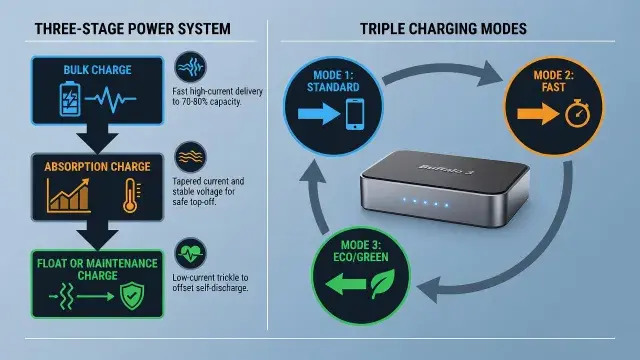
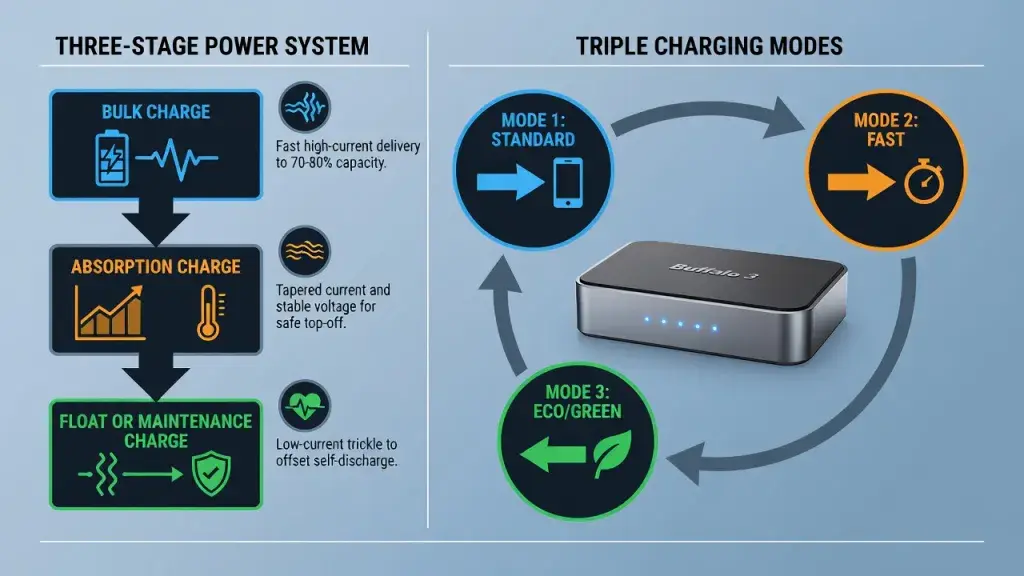
The core of the device's charging intelligence lies in its three-stage power system. Each stage has a distinct job, and skipping or rushing any one of them would compromise battery health.
Stage One: Bulk Charge
This is the fastest phase. The device delivers maximum safe current to bring the battery from a low state up to roughly 70-80 percent capacity quickly. Speed matters here because the battery can tolerate higher current when it's significantly depleted without excessive heat buildup.
Stage Two: Absorption Charge
As the battery approaches full capacity, current tapers while voltage holds steady. This stage prevents overcharging and allows the cells to settle without the risk of overheating that constant high current would cause.
Stage Three: Float or Maintenance Charge
Once the battery reaches full capacity, the system drops to a trickle current that simply offsets natural self-discharge. This keeps the battery topped off without subjecting it to continuous full-voltage stress, which is one of the leading causes of long-term capacity fade.
- Bulk stage: fast, high-current delivery for rapid initial charging
- Absorption stage: tapered current with stable voltage for safe top-off
- Float stage: low-current maintenance to preserve full charge without stress
This layered design is what separates the Buffalo three-stage power system from cheaper alternatives that rely on a single constant-current, constant-voltage curve throughout the entire session.
Exploring the Buffalo Triple Charging Modes
While the three-stage system governs internal current behavior, the triple charging modes address something different: how power enters the device from external sources. This is where the Buffalo 3 shows real versatility.
Standard Wall Charging Mode
The default mode uses a conventional AC adapter. It's calibrated for overnight or extended charging sessions where speed isn't the priority - stability and battery preservation are.
Rapid Charging Mode
When time is limited, rapid mode increases the current ceiling during the bulk stage, cutting charging time noticeably. This mode draws more power and generates more heat, so the device's internal thermal regulation works harder to compensate.
Solar or Auxiliary Input Mode
For users relying on solar panels or auxiliary power banks, this third mode adjusts the charging curve to accommodate inconsistent or lower-voltage input. Solar output fluctuates with light conditions, so the device compensates by widening its acceptable voltage range rather than rejecting unstable input outright.
Together, these three modes give the Buffalo triple charging modes system a flexibility that single-mode devices simply cannot match. A user isn't locked into one charging behavior regardless of circumstance - the device adapts to the source.
Buffalo Charging Specifications: 3 Charge Breakdown
Specifications tell the practical story behind the marketing language. Knowing the numbers helps set realistic expectations for charging time, output, and compatibility.
Input Voltage and Current Ranges
The device typically accepts a broad voltage range to accommodate the three input modes described above. Wall charging operates within a standard fixed range, while solar/auxiliary mode tolerates wider fluctuation by design.
Output Current During Each Stage
Bulk stage output runs at the highest safe current the battery chemistry allows. Absorption stage current typically drops by a significant margin as voltage stabilizes. Float stage current is minimal - just enough to counteract self-discharge.
Compatibility Considerations
Not every cable or adapter will unlock every mode. Rapid charging mode, for instance, usually requires a compatible adapter capable of delivering the higher current ceiling; using a basic cable will default the device back to standard charging behavior regardless of which mode is selected.
Practical Benefits of the Three-Charge System
Beyond the technical explanation, the real question is what this means for someone using the device day to day.
Extended Battery Lifespan
Because the three-stage power system reduces heat and overcharging stress, the battery retains higher capacity for longer compared to devices using a single-curve charging approach.
Flexibility Across Environments
Whether plugged into a wall outlet, a portable power bank, or a solar panel, the triple charging modes ensure the device charges appropriately rather than forcing one behavior onto every source.
Reduced Risk of Overcharging Damage
The float stage acts as a safeguard against the kind of prolonged full-voltage exposure that shortens battery life in less sophisticated devices.
Frequently Asked Questions
Does using rapid charging mode damage the battery over time?
Occasional use of rapid mode is generally safe because the three-stage system still regulates heat and voltage internally. Frequent, exclusive reliance on rapid mode, however, can accelerate wear slightly compared to standard charging, simply due to the higher average current involved.
Can I switch between the three charging modes mid-session?
Yes, switching modes mid-charge is supported, and the device will recalculate the appropriate stage based on current battery percentage rather than restarting the entire cycle from scratch.
Why does solar charging take longer than wall charging?
Solar input mode is designed to tolerate lower and fluctuating voltage, which naturally results in a slower bulk stage. The tradeoff favors compatibility with inconsistent power sources over raw charging speed.
Is the three-stage power system unique to this device, or is it common in similar products?
Staged charging exists in various forms across quality battery-powered devices, but the specific combination of three internal stages paired with three external input modes is a distinguishing feature of this particular design.
What happens if I leave the device on float charge for days?
Float stage is designed for exactly that scenario. The trickle current only offsets natural self-discharge, so leaving the device connected for extended periods after reaching full charge does not cause the overcharging stress associated with older charging technologies.
Do all three charging modes require different cables?
Standard and rapid modes typically use the same cable, though rapid mode needs a compatible high-current adapter to actually reach its higher ceiling. Solar/auxiliary mode often requires a separate input adapter suited to variable voltage sources.